




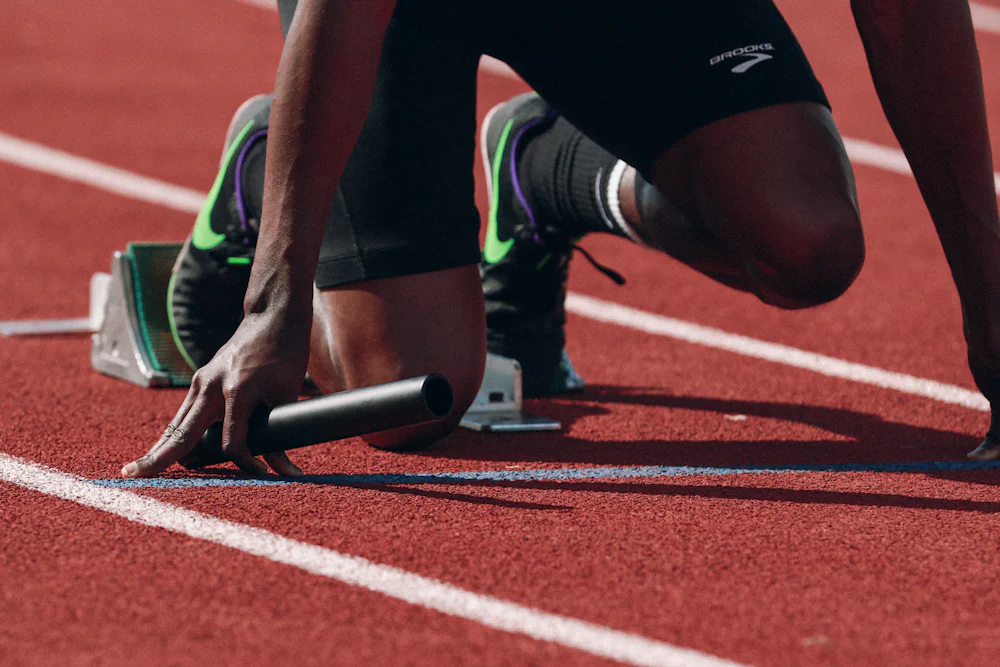
Inside the exchange zone
Less than a second to get it right
A relay changeover lasts less than a second, but it can win or lose a race. We spent a week with the relay squads to see how they practise it.
In the 4×100 m, the baton has to pass between two athletes running at close to full speed, inside a zone thirty metres long. Get it right and the baton never slows down. Get it wrong and the race is over.
The check mark
Every outgoing runner has a check mark on the track. When the incoming runner reaches it, the outgoing runner starts to sprint. The mark is set in training and adjusted on the day, depending on the wind and how fast the incoming runner is running.
If I go too early, they can't catch me. Too late, and they run into me. The mark is everything.
How the squads practise
- Walking changeovers to learn the hand position and the call.
- Half-speed changeovers in the zone, repeated until they are automatic.
- Full-speed changeovers at the end of sessions, filmed from the side.
- Race simulations with all four runners before every meeting.
The upsweep pass
The squads use an upsweep pass: the incoming runner brings the baton up into the outgoing runner's open hand. It is safer at full speed than a downward pass, and it lets the squad keep the same hand on every leg.
On race day
Before the race, each pair runs two practice changeovers on the back straight to check their marks. The squads raced at the Autumn Relay Cup to close the season; the results are on the results page, and the next relay meetings are on the events page.





Stay up to date
One email after each meeting: results, stories and the next dates on the calendar.